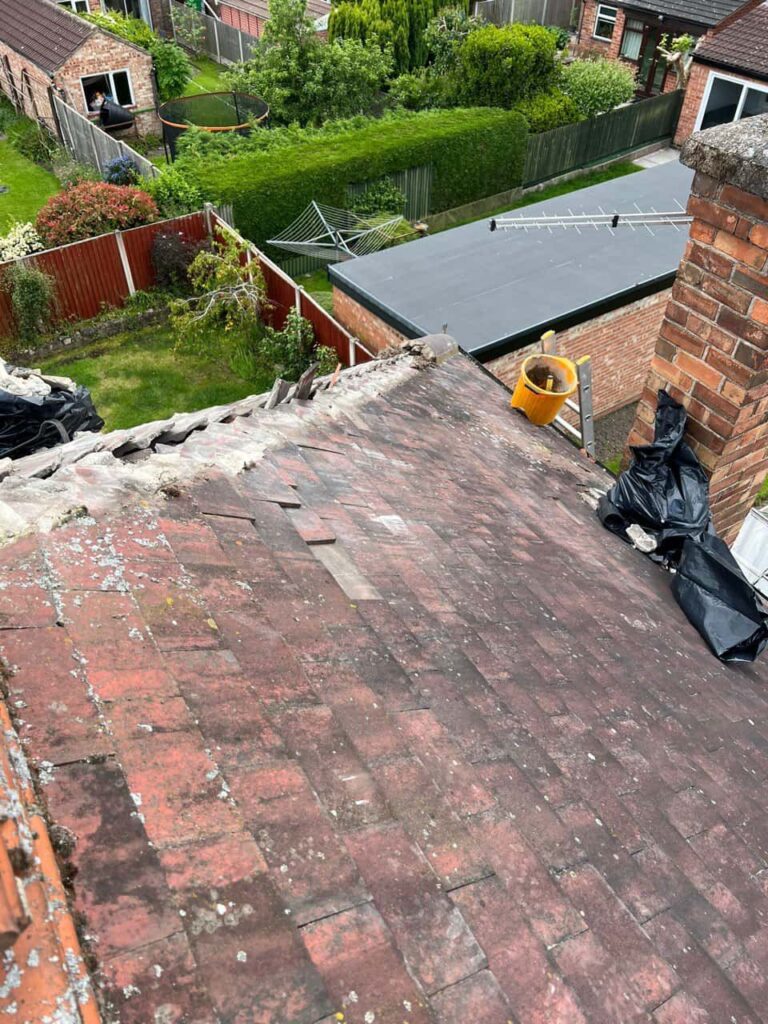
Roof replacement is often associated with obvious failure: persistent leaks, widespread damage or a roof that has reached the point where repairs are becoming increasingly difficult. However, waiting until major problems develop is not always the most practical way to manage an ageing roof. In some circumstances, there can be value in considering replacement while the roof is still functioning but showing clear signs of widespread deterioration.
For property owners in Barton-upon-Humber, Lincolnshire, the decision should be based on the overall condition of the roof rather than one isolated defect or its age alone. A sound roof with a small localised problem may be perfectly suitable for repair. By contrast, a roof showing deterioration across several areas may warrant a broader assessment before leaks and associated defects become more established.
When Should You Start Considering Roof Replacement?
There is no single warning sign that automatically means a roof needs replacing. The condition of the covering, fixings, flashing, ridges, valleys, roofline and underlying structure all contribute to the decision.
The key distinction is between localised defects that can be repaired effectively and deterioration that is becoming widespread across the roofing system. Recognising that difference early can help property owners make a planned decision rather than waiting for obvious failure.
Roof Replacement Does Not Have to Begin With a Major Leak
A roof can deteriorate substantially before water starts dripping through a ceiling.
The outer covering is the first visible part of the roofing system, but moisture may travel through several layers and along structural components before becoming noticeable inside the property.
This means the absence of an obvious leak does not necessarily confirm that every part of the roof remains in good condition.
Visible deterioration across several areas can justify professional assessment even when the interior appears dry.
A Roof Can Still Be Functional While Showing Signs of Decline
Roof deterioration is often gradual.
Tiles can become damaged, mortar can deteriorate, flashing can develop defects and individual sections can become increasingly vulnerable over time.
At first, these changes may not significantly affect the roof’s performance.
The important question is whether the deterioration remains confined to individual areas or is becoming representative of the roof as a whole.
One Defect Usually Tells a Different Story From Many Defects
A single slipped tile does not normally justify complete roof replacement.
Neither does one small flashing defect or an isolated damaged section.
Localised problems can often be repaired effectively where the surrounding roof remains in satisfactory condition.
Replacement becomes more relevant when numerous defects are developing across different parts of the roof and repairs are no longer addressing an isolated problem.
Look at the Overall Pattern of Deterioration
When deciding whether replacement deserves consideration, patterns matter.
One damaged tile is a localised issue. Several areas containing cracked, slipped or deteriorating tiles can indicate a broader change in condition.
Likewise, one previous repair may be entirely normal, while numerous repair areas spread across the roof can provide useful information about how the complete covering is ageing.
A professional assessment should therefore consider the whole roof rather than concentrating only on the most obvious defect.
Recurring Repairs Can Be an Important Indicator
Occasional roof repairs do not necessarily indicate that replacement is needed.
Roofs can develop isolated problems while remaining dependable overall.
However, if new defects continue appearing in different areas, it may be worth considering whether the underlying issue is becoming general deterioration rather than a series of unrelated problems.
At this stage, comparing continued localised repairs with the condition of the complete roof can provide a clearer long-term picture.
Previous Repairs Should Be Assessed Alongside New Problems
Older roofs often contain evidence of previous maintenance.
That is not automatically concerning. Properly completed repairs can remain effective for a considerable period.
The important factor is what is happening around those repairs.
If previously repaired areas remain sound but unrelated defects are appearing elsewhere, this may suggest that other parts of the roof are reaching a similar stage of deterioration.
Increasing Numbers of Slipped Tiles Deserve Attention
A single slipped tile can often be dealt with as a straightforward local repair.
If tiles begin slipping repeatedly across several areas, the situation deserves broader investigation.
The problem may involve individual tiles, their fixings or other aspects of the roof covering.
Simply replacing each slipped tile as it appears may not provide a complete understanding of why the problem is becoming more frequent.
Cracked and Broken Tiles Can Become More Significant When Widespread
Individual tiles can crack or break without indicating a problem with the complete roof.
However, where damaged tiles are becoming common across several roof slopes, their condition can form part of a wider deterioration pattern.
A professional roofer can assess how much of the existing covering remains serviceable and whether selective repairs continue to provide an appropriate solution.
The Condition of the Roof Covering Matters as a Whole
Roof replacement decisions should not be based solely on the worst-looking section.
Some roofs contain one damaged area surrounded by covering that remains in good condition.
Others may appear reasonably consistent from ground level but contain deterioration distributed throughout the roof.
Assessing the complete covering helps establish whether there is enough sound material remaining for localised repair to remain the sensible approach.
Ridges Can Provide Useful Clues
The ridge forms an important part of many pitched roofs and is exposed to weather throughout the year.
Deterioration around ridge components does not automatically mean that a roof requires replacement.
However, ridge problems appearing alongside widespread tile defects, deteriorating mortar and other changes can contribute to the overall assessment.
Roof condition should always be judged by considering how multiple components are performing together.
Valleys Need Particular Attention
Roof valleys manage concentrated flows of rainwater between adjoining roof slopes.
Because of their position and function, deterioration within a valley can result in moisture entering surrounding areas.
A localised valley defect may be repairable.
Where valley deterioration forms part of wider problems affecting tiles, flashing and other roof details, it can strengthen the case for assessing whether more comprehensive work would be appropriate.
Flashing Problems Can Often Be Repaired Independently
Lead flashing and other weatherproofing details around roof junctions are common sources of localised defects.
Problems in these areas do not automatically require replacement of the complete roof.
Where the surrounding covering remains sound, targeted repair may be entirely appropriate.
The decision changes when flashing defects are only one of several signs that the roof is deteriorating more generally.
Roof Junctions Can Reveal Developing Weaknesses
Areas where different roof sections meet often require careful attention.
Water naturally travels towards junctions, valleys and other changes in roof geometry.
Defects in these areas may remain relatively localised, but repeated problems across several junctions can indicate that the roof needs a more comprehensive assessment.
Understanding whether the defects are connected helps determine the appropriate scale of work.
Internal Damp Can Develop Before an Obvious Leak
Roof problems do not always produce immediate dripping water.
Early signs can include faint ceiling marks, discolouration or dampness within the roof space.
These symptoms should be investigated rather than simply waiting to see whether they become more obvious.
Finding the cause early can establish whether the problem is confined to one section or reflects deterioration affecting a larger part of the roof.
Roof-Space Inspection Can Reveal Problems Hidden From Below
The underside of the roof can provide useful evidence about its performance.
Moisture marks, staining on timbers or damp areas beneath the covering can sometimes reveal defects before significant internal symptoms appear.
The position of these signs can also help establish whether water is entering through one localised point or several areas.
This information can be valuable when deciding between repair and more extensive work.
Water Can Travel Away From the Entry Point
One reason roof problems can be difficult to assess is that the location of an internal damp patch may not correspond directly with the external defect.
Water can move along roofing materials, timbers and other surfaces before becoming visible.
This is why replacing the component immediately above an internal stain does not always resolve the underlying problem.
Professional investigation aims to identify the actual route of moisture before recommending the appropriate work.
Repeated Leaks in Different Areas Can Change the Decision
One correctly diagnosed leak may only require a local repair.
If separate leaks develop in different areas over time, it becomes increasingly important to consider the condition of the complete roof.
Multiple water-entry points can suggest that deterioration is no longer confined to one vulnerable section.
This does not automatically mean replacement is necessary, but it provides a strong reason for a broader assessment.
Waiting for Interior Damage Is Not a Useful Test of Roof Condition
A roof does not need to produce significant internal damage before its condition can be evaluated.
External defects, roof-space moisture and widespread deterioration can all provide earlier information.
Waiting until water penetration becomes severe can allow a developing problem to affect a larger area.
A condition-led assessment provides a better basis for decision-making than waiting for the roof to demonstrate obvious failure.
Age Should Be Considered Alongside Condition
Older roofs deserve appropriate attention, but age alone should not determine whether replacement is required.
Two roofs of a similar age can be in very different condition depending on their materials, exposure, previous maintenance and individual construction.
An older roof that remains sound may continue to be suitable for repair when occasional defects arise.
A roof showing widespread deterioration should be assessed based on those defects rather than replaced simply because of its age.
Surface Appearance Does Not Tell the Whole Story
A roof can look weathered without necessarily needing replacement.
Discolouration, moss or general ageing can change its appearance while the underlying covering remains functional.
Conversely, a roof that appears relatively tidy from the ground can contain slipped components, damaged flashing or deterioration that is difficult to see.
Replacement decisions should therefore be based on functional and structural condition rather than appearance alone.
Moss Does Not Automatically Mean the Roof Has Failed
Moss growth is common on some roof surfaces and should not, by itself, be treated as evidence that complete replacement is necessary.
The more important question is the condition of the roofing materials beneath and around it.
If tiles remain sound and other components are performing properly, moss alone does not establish the need for replacement.
A professional assessment can separate cosmetic appearance from genuine roofing defects.
Weather Exposure Can Reveal Existing Weaknesses
Rain and wind frequently expose defects that have been developing gradually.
A tile that has become insecure may move during windy conditions, while a deteriorating junction may become noticeable during prolonged rainfall.
The weather is not always the original cause of the problem.
Instead, it can reveal weaknesses that were already present.
Repeated weather-related problems can therefore provide useful evidence about the roof’s wider condition.
A Roof That Needs Attention After Every Period of Poor Weather Deserves Assessment
Occasional storm-related damage can occur even on otherwise sound roofs.
However, if new defects repeatedly become apparent after windy or wet conditions, it may be worth examining why the roof has become increasingly susceptible.
Repeated tile movement, water ingress or deterioration in several locations can suggest that isolated repairs are no longer the only consideration.
Understanding the underlying pattern can help determine whether planned replacement should be discussed.
Localised Repairs Remain Valuable When the Surrounding Roof Is Sound
Considering replacement early does not mean that every ageing roof should be replaced.
Localised repair remains highly appropriate where the problem is clearly defined and the surrounding materials remain serviceable.
For example, one slipped tile, a small flashing defect or a limited damaged section can often be addressed without disturbing the rest of the roof.
The value of professional assessment lies partly in identifying when replacement is not necessary.
Replacement Becomes More Relevant as Sound Areas Become Limited
A roof can reach a stage where repairs are technically possible but increasingly fragmented.
If defects are distributed throughout numerous sections, each repair may address only one small part of a wider deterioration pattern.
At this point, it can be useful to consider how much of the existing roof remains dependable.
The decision should focus on the complete condition rather than whether another individual repair can physically be carried out.
Multiple Connected Problems Can Support a Broader Approach
Roofing components work together.
Tiles or slates shed water towards gutters and valleys, while flashing protects vulnerable junctions and other details help maintain a continuous weather-resistant covering.
When several connected components begin deteriorating, treating every symptom separately may become less effective.
A broader assessment can establish whether the defects have reached the stage where planned replacement provides a more coherent solution.
Replacement Can Address the Roof as One Complete System
One advantage of roof replacement is that the roof can be approached comprehensively rather than as a collection of separate repair areas.
The existing covering can be removed and the relevant supporting elements assessed as part of the work.
This is particularly relevant where repeated defects have made the condition beneath the surface difficult to understand fully.
The decision to replace should still be based on need rather than simply the opportunity to install something new.
Planned Replacement Can Avoid Waiting for Widespread Failure
There is an important difference between replacing a serviceable roof prematurely and planning replacement when clear deterioration is already established.
If assessment shows that defects are becoming widespread and the existing covering is approaching the end of its practical serviceability, waiting for substantial failure may provide little advantage.
Considering replacement at this stage allows the decision to be based on observable condition rather than an emergency caused by a major leak.
Early Consideration Does Not Mean Immediate Replacement
Thinking about replacement and deciding to replace the roof are not the same thing.
An assessment may establish that the roof still has substantial sound areas and that repair remains appropriate.
Alternatively, it may show that deterioration is sufficiently widespread to make replacement worth considering.
The purpose of early assessment is to provide useful information before the decision becomes unavoidable.
Warning Signs That a Broader Roof Assessment May Be Appropriate
It may be worth assessing the complete roof where:
- repairs are becoming increasingly frequent;
- slipped or damaged tiles are appearing in several areas;
- different parts of the roof have developed separate leaks;
- previous repair areas are surrounded by new deterioration;
- several roof junctions are showing defects;
- widespread deterioration is visible across the covering;
- roof-space moisture is appearing in more than one location;
- the roof repeatedly develops problems during poor weather;
- multiple components are reaching a similar stage of deterioration;
- you are unsure whether another isolated repair will address the wider condition.
None of these signs automatically proves that replacement is required. They indicate that looking at the complete roof may be more useful than concentrating on the latest defect alone.
Avoid Assuming Every New Problem Means the Roof Has Reached the End
It is equally important not to overreact to ordinary repair requirements.
Even well-performing roofs can develop occasional defects.
One repair followed several years later by another unrelated problem does not necessarily indicate widespread failure.
The frequency, distribution and underlying causes of defects provide much more useful information than the simple fact that a roof has required previous maintenance.
Repair or Replacement Should Be a Condition-Led Decision
The most appropriate roofing work depends on what is actually found during assessment.
Where defects are localised and the surrounding roof remains sound, repair can preserve the existing covering effectively.
Where deterioration is extensive and new problems continue appearing across multiple areas, replacement may deserve stronger consideration.
A condition-led approach prevents both unnecessary replacement and repeated repairs to a roof whose overall condition has substantially declined.
Professional Roof Assessment Helps Provide a Clearer Picture
Roof problems can look straightforward from ground level while involving several connected components.
Professional inspection allows the condition of the covering, ridges, valleys, flashing, junctions and other relevant areas to be considered together.
This makes it easier to distinguish between a roof with an isolated defect and one showing a wider pattern of deterioration.
The resulting decision can then be based on the actual condition rather than assumptions about age or appearance.
Roof Replacement in Barton-upon-Humber, Lincolnshire
At TRP Roofing Barton-upon-Humber, we understand that deciding whether to continue repairing a roof or start considering replacement can be difficult, particularly when the roof has not yet developed major problems.
The starting point should be a clear assessment of its current condition. Where deterioration remains localised, appropriate repair may be all that is required. Where defects have become widespread or are appearing increasingly frequently, a broader replacement approach may be worth considering before the roof deteriorates further.
For property owners in Barton-upon-Humber, Lincolnshire, this provides a practical way to make roofing decisions based on what the roof genuinely requires rather than waiting for obvious failure.
Conclusion
Roof replacement can be worth considering before major problems begin, but only where the condition of the roof supports that decision. A small leak, one slipped tile or an isolated flashing defect does not automatically justify replacing an otherwise sound roof.
The situation changes when deterioration becomes widespread. Recurring repairs, defects across several areas, repeated water ingress and multiple ageing components can indicate that the roof should be assessed as a complete system rather than as a series of separate problems.
Considering replacement early does not mean replacing a roof prematurely. It means recognising when the pattern of deterioration has changed and obtaining a clear understanding of the available options before significant failure develops.
If your roof in Barton-upon-Humber, Lincolnshire is developing increasingly frequent problems or you are unsure whether continued repairs remain the appropriate approach, contact TRP Roofing Barton-upon-Humber. We can assess its overall condition and recommend suitable roofing work based on what the property genuinely requires.
Call us on: 01652 241 127
Click here to find out more about TRP Roofing Barton-upon-Humber
Click here to complete our contact form and see how we can help with your roofing needs.